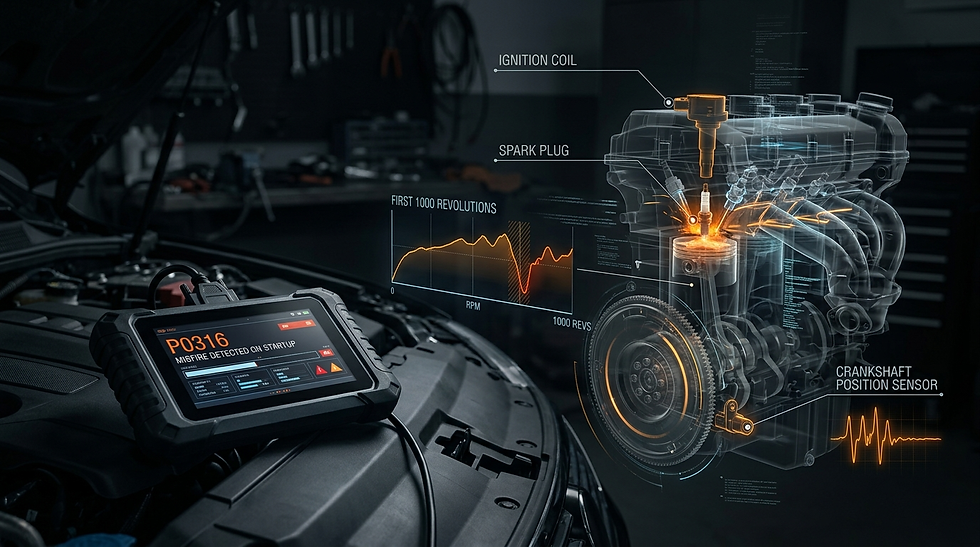
P0319 Code: Causes, Symptoms, Diagnosis & How to Fix It

P0319 means “Rough Road Sensor B Signal Circuit.” It is a generic OBD2 powertrain trouble code indicating that the PCM has detected a problem with the signal from the vehicle's rough-road sensor B circuit.
The rough-road detection system helps the PCM determine whether changes in crankshaft speed are caused by a genuine engine misfire or by the vehicle traveling over an uneven road.
Depending on the vehicle, rough-road information may come from a dedicated accelerometer or sensor. Other vehicles may use ABS wheel-speed information and the Electronic Brake Control Module (EBCM) to determine road conditions.
The exact sensor arrangement and diagnostic procedure vary by manufacturer, so vehicle-specific service information is important when diagnosing P0319.
P0319 Code Symptoms
Possible symptoms of P0319 include:
Check Engine Light
ABS warning light
Traction-control warning light
Stability-control warning light
Intermittent engine hesitation
Rough-running or apparent misfire symptoms
False or additional misfire codes
Warning lights that appear when driving over rough roads
No noticeable drivability symptoms
Many vehicles can continue to drive normally with P0319, particularly when the vehicle is traveling on smooth roads. However, the code can interfere with the PCM's ability to accurately interpret crankshaft-speed changes.
Common Causes of P0319
Several conditions can trigger a P0319 code.
1. Faulty Rough-Road Sensor B
If the vehicle has a dedicated second rough-road sensor, an internal sensor failure can produce an incorrect or missing signal.
2. Damaged or Broken Wiring
An open circuit, short to ground, short to voltage, chafed wire, or high-resistance connection can interrupt the sensor B signal.
3. Corroded or Loose Connector
Moisture, corrosion, damaged terminals, or an improperly seated connector can cause intermittent or unreliable sensor signals.
4. ABS or Wheel-Speed Sensor Problem
Some vehicles use wheel-speed information from the ABS system as part of rough-road detection. A faulty wheel-speed sensor or damaged wiring can therefore contribute to P0319.
5. EBCM or ABS Communication Problem
If rough-road information is supplied by the brake control system, an EBCM fault or communication problem can prevent the PCM from receiving the expected data.
6. Sensor Mounting Problem
A loose or incorrectly installed accelerometer or rough-road sensor may provide inaccurate information.
7. PCM Software or Configuration Problem
Incorrect programming, calibration, or a PCM fault can occasionally cause the controller to misinterpret the rough-road signal.
8. Related Crankshaft or Misfire Detection Problem
Because rough-road information is used alongside crankshaft-speed information for misfire monitoring, related crankshaft position or misfire-monitoring faults should also be checked when multiple codes are present.
How Rough-Road Detection Works
The PCM monitors very small changes in crankshaft speed to help identify engine misfires.
However, driving over potholes, uneven pavement, or other rough surfaces can create changes in wheel and drivetrain movement that resemble crankshaft-speed variations caused by a misfire.
Rough-road detection provides additional information that helps the PCM distinguish road-induced movement from an actual combustion problem.
Some vehicles use dedicated accelerometers or rough-road sensors, while others use ABS wheel-speed data and the EBCM to determine road conditions.
How to Diagnose P0319
Because P0319 can involve different vehicle architectures, identify how the vehicle generates its rough-road information before replacing any parts.
Step 1: Scan for All Trouble Codes
Use an OBD2 scanner to retrieve all stored and pending codes.
Pay particular attention to:
P0318
P0317
P0300-series misfire codes
ABS codes
Wheel-speed sensor codes
Traction-control codes
Communication codes
Additional codes can help identify whether the problem is isolated to sensor B or involves a larger ABS or communication issue.
Step 2: Check Technical Service Bulletins
Search technical service bulletins for the exact year, make, model, engine, and drivetrain.
Manufacturer information may identify known sensor, wiring, calibration, or module problems associated with P0319.
Step 3: Determine the Vehicle's Rough-Road System
Before looking for a physical sensor, determine whether the vehicle actually uses a separate rough-road sensor B.
Some systems use a second physical accelerometer, while others derive the second input from wheel-speed data supplied by the ABS/EBCM.
Step 4: Inspect the Sensor and Connector
If the vehicle has a dedicated sensor B, inspect it for:
Physical damage
Loose mounting
Corrosion
Water intrusion
Damaged connector pins
Poor connector engagement
Correct any obvious physical or connection problem before performing further testing.
Step 5: Inspect the Wiring
Carefully inspect the sensor B circuit for:
Broken wires
Chafing
Pinched wiring
Corrosion
Loose terminals
Short circuits
Damaged insulation
Pay particular attention to areas where the harness is exposed to vibration, heat, suspension movement, or road debris.
Step 6: Test Power, Ground & Signal
Using the vehicle's wiring diagram and manufacturer specifications, test the sensor's power supply, ground, signal circuit, continuity, and resistance as applicable.
Do not assume a universal voltage or resistance value because sensor designs differ between vehicles.
Step 7: Check ABS and Wheel-Speed Data
If the vehicle uses ABS data for rough-road detection, use an advanced scan tool to monitor wheel-speed information.
Compare the wheel-speed readings and look for intermittent dropouts, implausible readings, or a sensor that behaves differently from the others.
Step 8: Check for EBCM Communication Problems
Scan the ABS/EBCM module separately.
If it contains wheel-speed, communication, or internal module codes, those problems may be responsible for the rough-road signal reaching the PCM.
Step 9: Monitor Live Data
Where supported, monitor the rough-road sensor B PID or related data with an advanced scan tool.
A controlled road test may help determine whether the signal changes correctly when the vehicle encounters normal road variations.
Step 10: Clear Codes and Retest
After repairing the confirmed fault, clear the codes and perform an appropriate road test.
Confirm that P0319 does not return and that any ABS, traction-control, or engine-related symptoms have been resolved.
How to Fix P0319
The correct repair depends on the cause. Possible repairs include:
Replace a faulty rough-road sensor B
Repair damaged sensor wiring
Repair corroded or loose connectors
Correct a sensor mounting problem
Replace a faulty ABS wheel-speed sensor
Repair wheel-speed sensor wiring
Repair or replace a damaged tone ring
Correct EBCM communication problems
Perform required sensor calibration or initialization
Update or reprogram a control module when manufacturer information specifies it
Repair or replace a control module only after testing confirms failure
Avoid replacing the PCM or ABS module simply because P0319 is stored. Proper circuit and module testing should identify the actual cause first.
Is P0319 Serious? Can You Drive With It?
P0319 is generally not an immediate engine-failure code.
Many vehicles continue to drive normally, particularly on smooth roads. However, the fault can reduce the PCM's ability to distinguish road-induced crankshaft variations from genuine misfires.
If ABS, traction-control, or stability-control warning lights are also illuminated, the related safety systems should be diagnosed promptly.
A short drive to a repair facility may be reasonable if the vehicle operates normally and there are no major warning lights or braking problems.
Avoid unnecessary driving if you experience severe misfires, loss of power, braking problems, or significant stability-control issues.
P0319 vs P0318
P0318 means Rough Road Sensor A Signal Circuit.
P0319 means Rough Road Sensor B Signal Circuit.
The two codes identify different rough-road signal channels. If both P0318 and P0319 appear together, the shared power supply, ground, communication system, or control module may deserve additional attention.
The exact meaning of channels A and B depends on the vehicle's system design.
P0319 vs P0317
P0317 means Rough Road Hardware Not Present.
P0319 indicates a problem with the Rough Road Sensor B signal circuit.
P0317 can point toward missing or unavailable rough-road hardware, while P0319 is more specifically associated with the second rough-road signal.
P0319 vs P0300
P0319 indicates a rough-road sensor B circuit problem.
P0300 means Random/Multiple Cylinder Misfire Detected.
P0319 itself does not mean that the engine has a confirmed misfire. A problem with rough-road detection can, however, interfere with how the PCM interprets crankshaft-speed changes during misfire monitoring.
Frequently Asked Questions
What does P0319 mean?
P0319 means Rough Road Sensor B Signal Circuit. It indicates that the PCM has detected a problem with the second rough-road detection signal or its related circuit.
Does every vehicle have a Rough Road Sensor B?
No. The exact rough-road detection system varies by vehicle. Some vehicles use a dedicated second sensor, while others use ABS wheel-speed information or another module to provide the required data.
Can an ABS sensor cause P0319?
Yes. On vehicles that use ABS wheel-speed information for rough-road detection, a faulty wheel-speed sensor or related wiring can contribute to P0319.
Can P0319 cause a misfire?
P0319 does not directly indicate a combustion misfire. However, a faulty rough-road signal can interfere with the PCM's ability to distinguish actual misfires from road-induced crankshaft-speed changes.
Is P0319 serious?
P0319 is usually not an immediate engine emergency, but it should be diagnosed. If ABS, traction-control, or stability-control warnings are also present, the vehicle should be inspected promptly.
Can I drive with P0319?
A short trip may be possible if the vehicle drives normally and no major safety-system warnings are present. If braking, ABS, traction control or engine performance is affected, have the vehicle inspected before continuing to drive.