P0316 Code: Causes, Symptoms, Diagnosis & How to Fix It
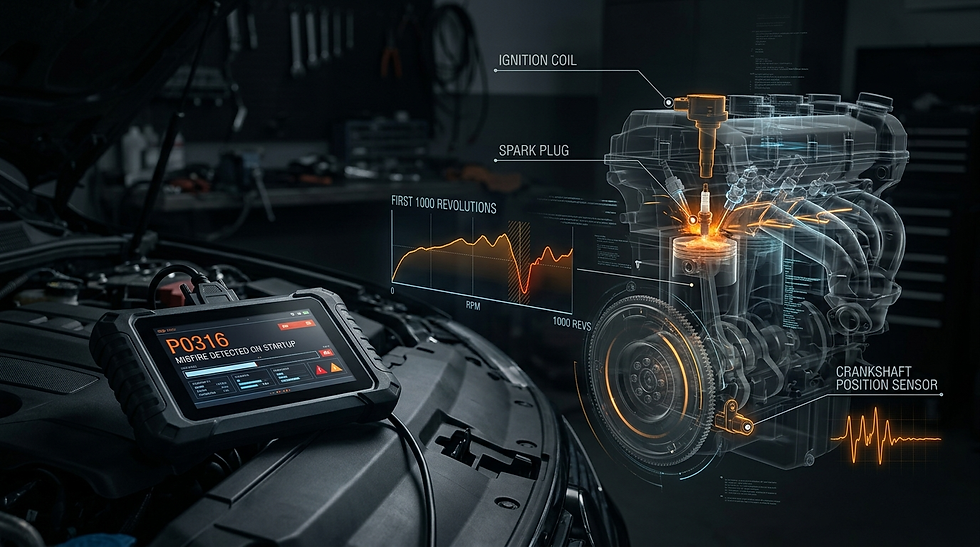
P0316 means “Misfire Detected on Startup — First 1,000 Revolutions.” It is a generic OBD2 powertrain trouble code indicating that the PCM has detected an engine misfire shortly after the engine starts, specifically within the first 1,000 crankshaft revolutions.
P0316 does not identify one particular cylinder. Instead, it tells you that the engine experienced a misfire during the initial period after startup.
This code may appear together with another misfire code, such as P0300 or a cylinder-specific code like P0301, P0302, or P0312. If another misfire code is present, diagnosing that code can help identify the underlying problem.
P0316 Code Symptoms
Common symptoms of P0316 may include:
Check Engine Light
Rough engine start
Rough idle immediately after starting
Engine shaking or vibration
Engine hesitation
Engine stumbling
Reduced engine performance
Engine stalling
Hard starting
Poor acceleration
Some vehicles may only experience rough running for a few seconds after startup, while others may continue to misfire after the engine reaches operating temperature.
Common Causes of P0316
Several problems can cause a P0316 code.
1. Ignition System Problem
A worn spark plug, weak ignition coil, damaged plug wire, or poor electrical connection can cause a misfire during startup.
2. Faulty Crankshaft Position Sensor
The crankshaft position sensor provides important engine-position information to the PCM. A faulty sensor or inconsistent signal can contribute to a P0316 condition.
3. Crankshaft Sensor Wiring Problem
Damaged wiring, loose connectors, corrosion, or an open circuit can interfere with the crankshaft sensor signal.
4. Fuel Delivery Problem
A weak fuel pump, restricted fuel delivery, or faulty injector can cause an incorrect air-fuel mixture during startup.
5. Poor Fuel Quality
Contaminated or poor-quality fuel can contribute to combustion problems and startup misfires.
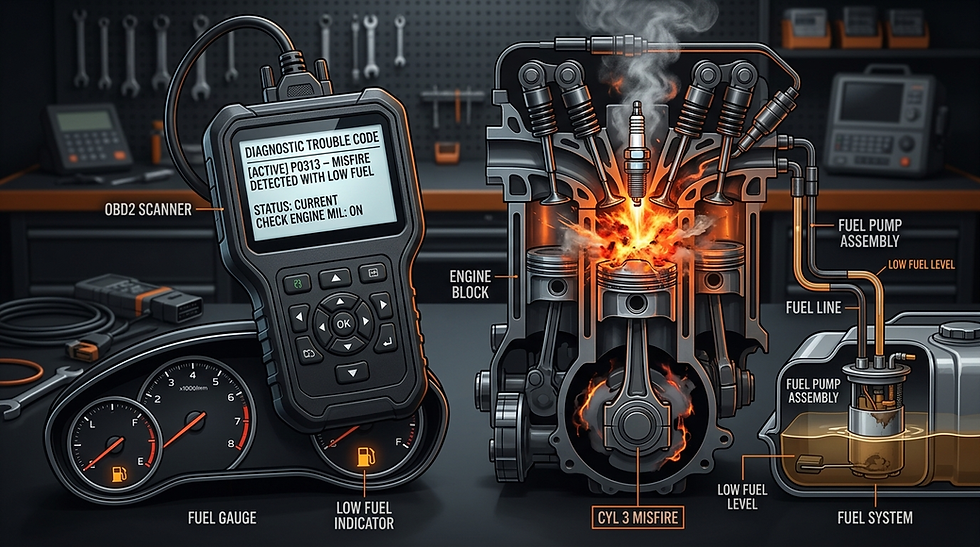
6. Very Low or Empty Fuel Tank
Running extremely low on fuel or allowing the vehicle to run out of fuel can contribute to misfire conditions.
7. Engine Mechanical Problem
Low compression, valve problems, timing issues, or other internal engine faults can cause a startup misfire.
8. PCM or Software Problem
A PCM problem or manufacturer-specific software issue can occasionally contribute to P0316. Some vehicles may also have technical service bulletins related to startup misfire conditions.
Why Does P0316 Happen Only at Startup?
P0316 is specifically focused on the engine's first 1,000 revolutions.
A vehicle may therefore run relatively well after startup while still setting the code because the misfire occurred during the initial monitoring period.
This makes cold-start conditions, startup fuel delivery, ignition performance, and crankshaft/camshaft sensor signals particularly important during diagnosis.
If the code occurs only when the engine is cold, components or conditions that change as the engine warms up should receive additional attention.
How to Diagnose P0316
The best approach is to determine whether another misfire code identifies the affected cylinder or whether the problem is related to a broader engine-management issue.
Step 1: Scan for Additional Codes
Connect an OBD2 scanner and retrieve all stored and pending trouble codes.
Pay particular attention to:
P0300
P0301–P0312
Crankshaft position sensor codes
Camshaft position sensor codes
Fuel-system codes
Ignition-related codes
If another specific misfire code is present, diagnose that code first when appropriate.
Step 2: Check Freeze-Frame Data
Review the freeze-frame information associated with P0316.
Look at engine temperature, RPM, fuel-system status, and other available parameters to determine the conditions when the misfire occurred.
Step 3: Inspect Spark Plugs
Check the spark plugs for:
Fouling
Excessive wear
Incorrect gap
Oil contamination
Carbon deposits
Physical damage
Replace plugs only when inspection or testing indicates they are faulty or outside specification.
Step 4: Test the Ignition System
Inspect ignition coils, plug wires, boots, and connectors.
On vehicles with individual ignition coils, swapping a suspected coil with another cylinder can help determine whether the misfire follows the coil. AutoZone also recommends visual inspection and coil swapping as practical misfire diagnostic steps.
Step 5: Check the Crankshaft Position Sensor
Inspect the crankshaft position sensor, connector, and wiring.
Look for damaged insulation, loose terminals, corrosion, or other signs of an electrical problem.
If necessary, use appropriate diagnostic equipment to verify the sensor signal.
Step 6: Check Fuel Delivery
Inspect the fuel system if ignition components appear normal.
Possible checks include:
Fuel pressure
Fuel pump operation
Injector operation
Injector wiring
Fuel quality
A weak fuel pump or injector problem can contribute to startup misfires.
Step 7: Check for Vacuum or Intake Problems
Inspect vacuum hoses, intake connections, and other areas where unmetered air could enter the engine.
A significant intake leak can create an incorrect air-fuel mixture and contribute to misfire conditions.
Step 8: Check Engine Compression and Timing
If ignition and fuel systems test normally, check engine compression and mechanical timing.
Low compression, valve problems, or incorrect timing can cause persistent startup misfires.
How to Fix P0316
The correct repair depends on the confirmed cause. Possible repairs include:
Replace worn or damaged spark plugs
Replace a faulty ignition coil
Repair damaged ignition wiring
Replace a faulty crankshaft position sensor
Repair crankshaft sensor wiring or connectors
Repair fuel injector problems
Repair fuel pump or fuel-pressure problems
Correct vacuum or intake leaks
Repair engine timing problems
Address low compression or internal engine damage
Reprogram the PCM when manufacturer service information identifies a software-related issue
After completing the repair, clear the code and perform multiple startup tests. Confirm that the engine starts smoothly and that P0316 does not return.
Is P0316 Serious? Can You Drive With It?
P0316 should be diagnosed promptly because it indicates that the engine is misfiring during startup.
A brief startup misfire may not always indicate severe engine damage, but repeated misfires can affect drivability and potentially damage emissions components.
If the Check Engine Light is flashing, the engine is shaking severely, the vehicle is stalling, or there is major power loss, avoid driving until the problem is diagnosed.
If the vehicle starts and runs normally after a brief startup stumble and the Check Engine Light remains steady, a short trip to a repair facility may be possible. However, the underlying cause should still be addressed.
P0316 vs P0315
P0316 indicates that a misfire was detected during the first 1,000 engine revolutions after startup.
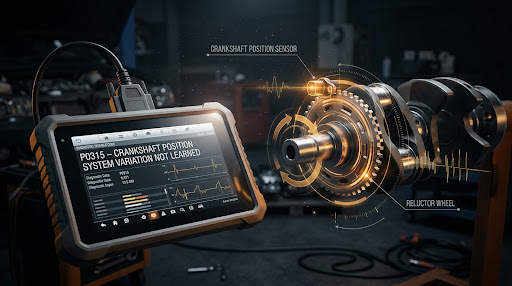
P0315 means Crankshaft Position System Variation Not Learned.
Although both codes can involve crankshaft-related information, P0316 specifically identifies a startup misfire, while P0315 concerns crankshaft position variation learning.
P0316 vs P0300
P0316 indicates a misfire detected during startup.
P0300 indicates Random/Multiple Cylinder Misfire Detected.
A vehicle can potentially have both codes if multiple misfires occur and one or more of them happen during the first 1,000 revolutions.
Frequently Asked Questions
What does P0316 mean?
P0316 means Misfire Detected on Startup During the First 1,000 Revolutions.
Can bad spark plugs cause P0316?
Yes. Worn, fouled, damaged, or incorrectly gapped spark plugs can contribute to startup misfires.
Can a bad crankshaft sensor cause P0316?
Yes. A faulty crankshaft position sensor or wiring problem can interfere with engine-position information and contribute to a P0316 condition.
Can P0316 be caused by a fuel problem?
Yes. Fuel quality, fuel pressure, a weak fuel pump, or a faulty injector can contribute to startup misfires.
Is P0316 safe to drive with?
It depends on the severity. If the vehicle has a flashing Check Engine Light, severe shaking, stalling, or major power loss, avoid driving until the problem is diagnosed.
Why does my car only misfire when starting?
A startup-only misfire can be related to ignition, fuel delivery, sensor signals, engine temperature, compression, or other conditions that are most noticeable during the initial engine revolutions.