P0317 Code: Causes, Symptoms, Diagnosis & How to Fix It

P0317 means “Rough Road Hardware Not Present.” It is a generic OBD2 powertrain trouble code indicating that the PCM has detected that the vehicle's system for identifying rough-road conditions is missing, unavailable, or not operating as expected.
Modern vehicles may use a dedicated rough-road sensor, accelerometer, wheel-speed sensors, or information from the ABS/EBCM system to determine whether the vehicle is traveling over an uneven surface.
This information is important because driving over rough roads can temporarily cause crankshaft-speed variations that may look similar to an engine misfire. The PCM uses rough-road information to help distinguish actual engine problems from road-induced variations.
The exact system differs between manufacturers, so the diagnostic procedure for P0317 depends heavily on the vehicle's year, make, model, and equipment.
P0317 Code Symptoms
P0317 can be different from many other engine codes because it may not always illuminate the Check Engine Light.
Possible symptoms include:
Check Engine Light
ABS warning light
Traction control warning light
Rough-running engine
Engine misfire symptoms
Intermittent engine hesitation
Unusual crankshaft-speed fluctuations
Other chassis or stability-control warnings
Some vehicles may have no noticeable drivability symptoms at all.
Common Causes of P0317
Several problems can trigger a P0317 code.
1. Missing or Faulty Rough-Road Sensor
Some vehicles use a dedicated road-surface or accelerometer sensor. If the sensor is missing, damaged, or malfunctioning, the PCM may set P0317.
2. ABS or Wheel-Speed Sensor Problem
Some vehicles use wheel-speed information to detect rough-road conditions. A faulty wheel-speed sensor can therefore contribute to incorrect rough-road detection.
3. Damaged Wiring or Connectors
Open circuits, short circuits, corrosion, loose terminals, or damaged wiring can interrupt communication between the sensor and control module.
4. Sensor Initialization Problem
A replacement rough-road sensor may require initialization or calibration before the vehicle can correctly recognize it.
5. ABS/EBCM Communication Problem
On vehicles that use the ABS or electronic brake control module to determine road conditions, a communication or module problem can affect rough-road detection.
6. Recent Suspension or Chassis Repairs
Certain repairs involving wheel-speed sensors, suspension components, ABS components, or related wiring may disturb the system and lead to a P0317 condition.
7. PCM or Module Software Problem
A programming or communication problem may occasionally contribute to the code after other possible causes have been eliminated.
How Rough-Road Detection Works
Rough-road detection helps the PCM understand whether changes in crankshaft speed are caused by an actual combustion problem or by the vehicle traveling across an uneven surface.
For example, when a vehicle drives over a severely uneven road, wheel-speed changes and vehicle movement can temporarily affect crankshaft-speed calculations. Without accurate rough-road information, the PCM could potentially interpret those changes as a misfire.
Depending on the vehicle, rough-road information may come from accelerometers, dedicated road sensors, ABS wheel-speed sensors, or the electronic brake control system.
How to Diagnose P0317
Because the rough-road system varies considerably between vehicles, always use vehicle-specific service information.
Step 1: Scan for All Trouble Codes
Use an OBD2 scanner to retrieve all stored and pending codes.
Pay particular attention to:
ABS codes
Wheel-speed sensor codes
Traction-control codes
Communication codes
Engine misfire codes
Other chassis-related codes
If other related codes are present, they may provide a more direct path to the cause.
Step 2: Check Technical Service Bulletins
Search for technical service bulletins for the specific vehicle.
Some P0317 conditions may be associated with manufacturer-specific diagnostic procedures or known issues.
Step 3: Inspect the Rough-Road Sensor
If the vehicle has a dedicated sensor or accelerometer, inspect it for:
Physical damage
Incorrect installation
Loose mounting
Corrosion
Water intrusion
Damaged wiring
Loose connectors
Step 4: Inspect Wheel-Speed Sensors
If the vehicle uses ABS wheel-speed sensors for rough-road detection, inspect the sensors and wiring at each wheel.
Look for damaged wires, loose connectors, contamination, or physical damage to the sensor or tone ring.
Step 5: Check ABS and Traction-Control Data
Use an advanced scan tool to monitor wheel-speed and related sensor data.
Compare the readings between wheels and look for an abnormal or intermittent signal.
Step 6: Check Sensor Initialization
If a rough-road sensor or related module was recently replaced, determine whether it requires initialization or calibration.
A new sensor may not function correctly until the required setup procedure has been completed.
Step 7: Test the System on the Road
When appropriate and safe, an advanced scan tool can be used while driving to monitor rough-road sensor information.
The goal is to determine whether the sensor or module produces the expected signal when the vehicle encounters road irregularities.
How to Fix P0317
The correct repair depends on the cause. Possible repairs include:
Replace a faulty rough-road sensor
Repair damaged sensor wiring
Repair corroded or loose connectors
Replace a faulty wheel-speed sensor
Repair damaged ABS sensor wiring
Repair or replace a damaged reluctor/tone ring
Initialize or calibrate a replacement sensor
Repair ABS/EBCM communication problems
Perform required module programming
Repair or replace a control module when testing confirms failure
Do not replace the PCM simply because P0317 is stored. The sensor, wiring, ABS system, and initialization procedure should be checked first.
Is P0317 Serious? Can You Drive With It?
P0317 is not necessarily an indication of an engine failure.
However, the code can be associated with the vehicle's ability to recognize rough-road conditions correctly. If ABS, traction control, or stability-control warning lights are also illuminated, the related chassis systems should be diagnosed promptly.
If the vehicle drives normally and there are no major warning lights or drivability problems, a short trip to a repair facility may be possible.
If the vehicle has braking, ABS, traction-control, or stability-control problems, drive cautiously and have the vehicle inspected as soon as possible.
P0317 vs P0316
P0317 relates to the rough-road detection system and indicates that the required rough-road hardware is not present or available.
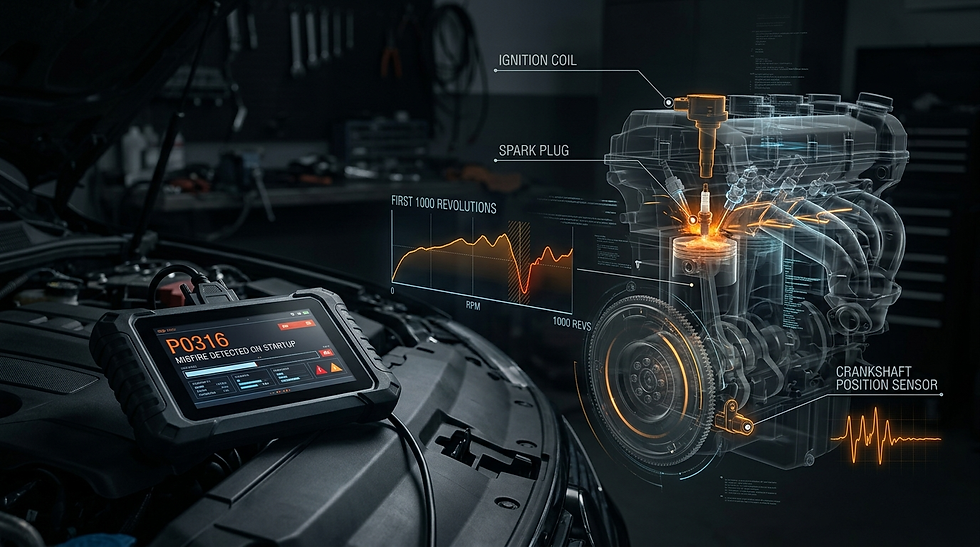
P0316 indicates a misfire detected during startup within the first 1,000 revolutions.
The two codes can both involve engine misfire monitoring, but they identify very different conditions.
P0317 vs P0318
P0317 means Rough Road Hardware Not Present.
P0318 refers to the Rough Road Sensor A Signal Circuit.
P0317 generally points toward the absence or availability of the rough-road detection hardware, while P0318 is more specifically associated with a signal-circuit problem.
Frequently Asked Questions
What does P0317 mean?
P0317 means Rough Road Hardware Not Present.
Can P0317 cause a Check Engine Light?
It may although P0317 does not always illuminate the Check Engine Light. Other warning lights, such as ABS or traction control, may appear depending on the vehicle.
Can a bad wheel-speed sensor cause P0317?
On vehicles that use ABS wheel-speed information for rough-road detection, a faulty wheel-speed sensor or related circuit can contribute to the problem.
Does P0317 mean my engine has a misfire?
Not necessarily. Rough-road conditions can create crankshaft-speed changes that resemble misfire activity, which is why the PCM needs reliable rough-road information.
Can I drive with P0317?
If the vehicle drives normally and no major warning lights are present, a short trip for diagnosis may be possible. If ABS, traction control, or stability-control systems are malfunctioning, have the vehicle inspected promptly.
Does replacing a rough-road sensor require calibration?
Some vehicles require initialization or calibration after replacing the sensor. Always follow the manufacturer's procedure for the specific vehicle.