P0174 Code: Causes, Symptoms, Diagnosis & How to Fix It
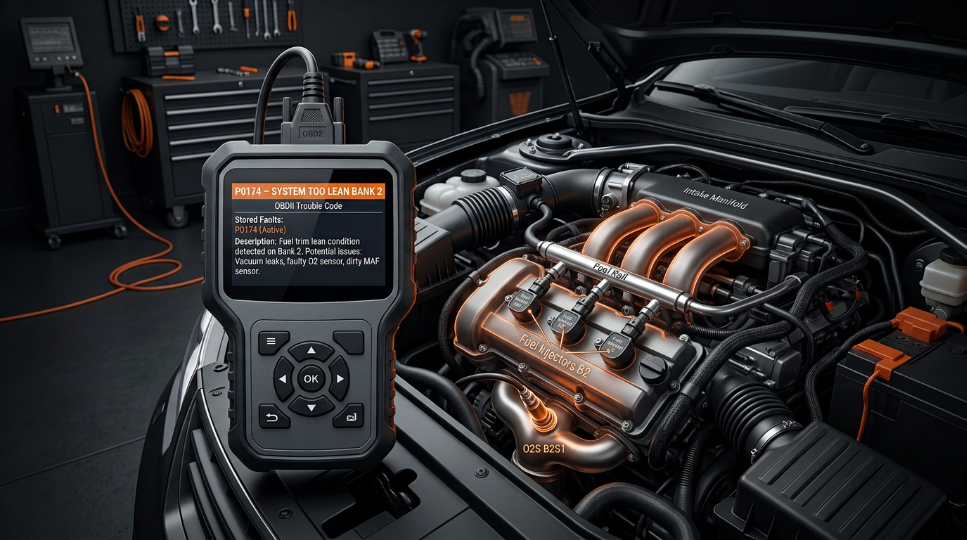
What Does the P0174 Code Mean?
The P0174 code means System Too Lean (Bank 2). Your vehicle's engine computer has detected that Bank 2 is operating with too much air or not enough fuel.
On engines with multiple cylinder banks, Bank 2 is the side that does not contain cylinder 1. The engine uses oxygen or air-fuel sensors to monitor the exhaust and determine whether the air-fuel mixture is within the expected range. When the computer has to add more fuel than normal to correct a lean condition, it can eventually set P0174.
P0174 does not automatically mean the oxygen sensor is bad. The underlying problem may be an intake leak, MAF issue, fuel-delivery problem, or another condition affecting the air-fuel mixture.
P0174 Code Symptoms
Some vehicles may have few noticeable symptoms other than the Check Engine Light. When drivability problems occur, common symptoms can include:
Check Engine Light
Rough or unstable idle
Hesitation during acceleration
Surging
Reduced engine power
Poor fuel economy
Hard starting
Engine misfires
Spark knock or detonation
The exact symptoms depend on the vehicle and severity of the lean condition.
Common Causes of P0174
Several problems can cause the engine to run too lean on Bank 2. The most common areas to inspect include:
1. Vacuum or Intake Leak
Unmetered air entering the engine after the MAF sensor can cause the computer to calculate the wrong air-fuel mixture. Check intake hoses, clamps, vacuum lines, and the PCV system for cracks or loose connections.
2. Dirty or Faulty MAF Sensor
A contaminated or inaccurate Mass Air Flow (MAF) sensor can incorrectly measure incoming air. This may cause the engine computer to deliver an incorrect amount of fuel.
3. Low Fuel Pressure
A weak fuel pump, restricted fuel filter, faulty pressure regulator, or another fuel-delivery problem can prevent the engine from receiving enough fuel.
4. Restricted or Faulty Fuel Injectors
A dirty or partially restricted injector can reduce fuel delivery to cylinders on the affected bank.
5. Exhaust Leak
An exhaust leak near an upstream oxygen or air-fuel sensor can sometimes introduce additional oxygen into the exhaust stream and contribute to an apparent lean reading.
6. Faulty Oxygen or Air-Fuel Sensor
A sensor can produce an incorrect reading, but it should be tested before replacement. P0174 alone does not prove that the sensor has failed.
How to Diagnose the P0174 Code
A systematic diagnosis can prevent unnecessary parts replacement.
1. Scan for additional codes
Use an OBD2 scanner to check for other DTCs. MAF, misfire, fuel-system, or sensor-related codes can provide important clues.
2. Check freeze-frame data
Review engine temperature, RPM, load, fuel trims, and other available information when P0174 was stored.
3. Inspect the intake system
Look for cracked intake boots, loose clamps, disconnected vacuum hoses, and damaged PCV components. Pay particular attention to areas after the MAF sensor.
4. Check the MAF sensor
Inspect the sensor and connector for contamination or damage. If cleaning is appropriate for your vehicle, use a product specifically designed for MAF sensors and follow the manufacturer's procedure.
5. Check fuel pressure
If there is no obvious air leak, test fuel pressure against the vehicle manufacturer's specifications. Low pressure can create a lean condition.
6. Check fuel trims and sensor data
Use your scanner's live-data function to compare short-term and long-term fuel trims. Compare Bank 1 and Bank 2 readings when the engine is operating normally.
7. Test for intake leaks
A smoke test can help identify small vacuum or intake leaks that are difficult to find visually.
Only replace an oxygen sensor, MAF sensor, injector, or other component after testing supports that diagnosis.
How to Fix P0174
The correct repair depends on the cause. Possible fixes include:
Repair cracked or disconnected vacuum hoses
Replace a damaged intake boot
Repair PCV system leaks
Clean or replace the MAF sensor when testing confirms a problem
Repair fuel-delivery problems
Replace or service restricted fuel injectors
Repair an exhaust leak affecting sensor readings
Replace a faulty oxygen or air-fuel sensor after proper testing
Repair damaged wiring or electrical connections
Clear the code and perform a confirmation drive after the repair
Because P0174 can have several different causes, replacing parts without diagnosis can result in unnecessary repair costs.
Can You Drive With P0174?
A vehicle with P0174 may still drive normally, but the code should not be ignored. A persistent lean condition can cause drivability problems such as hesitation, misfires, or reduced power.
If the engine is running very rough, misfiring, stalling, knocking, or the Check Engine Light is flashing, avoid continued driving and have the vehicle diagnosed promptly.
P0174 vs. P0171: What's the Difference?
Both codes indicate a lean fuel condition, but they apply to different engine banks:
Code | Meaning |
P0171 | System Too Lean — Bank 1 |
P0174 | System Too Lean — Bank 2 |
If both P0171 and P0174 appear together, the problem may affect the engine more broadly, such as an intake leak, MAF issue, or fuel-delivery problem. If only P0174 appears, diagnosis should pay particular attention to conditions affecting Bank 2.
Frequently Asked Questions
Is P0174 a serious code?
P0174 should be diagnosed rather than ignored. Severity depends on the underlying problem and whether the engine has noticeable drivability symptoms.
Can a dirty MAF sensor cause P0174?
Yes. A contaminated or faulty MAF sensor can contribute to a lean condition and should be inspected during diagnosis.
Can a vacuum leak cause P0174?
Yes. Unmetered air entering the intake system is a common cause of lean conditions.
Can low fuel pressure cause P0174?
Yes. Insufficient fuel pressure or another fuel-delivery problem can prevent the engine from receiving enough fuel.
Should I replace the O2 sensor for P0174?
Not automatically. P0174 identifies a lean condition, not necessarily a failed oxygen sensor. Proper diagnosis should identify the underlying cause before replacing parts.


